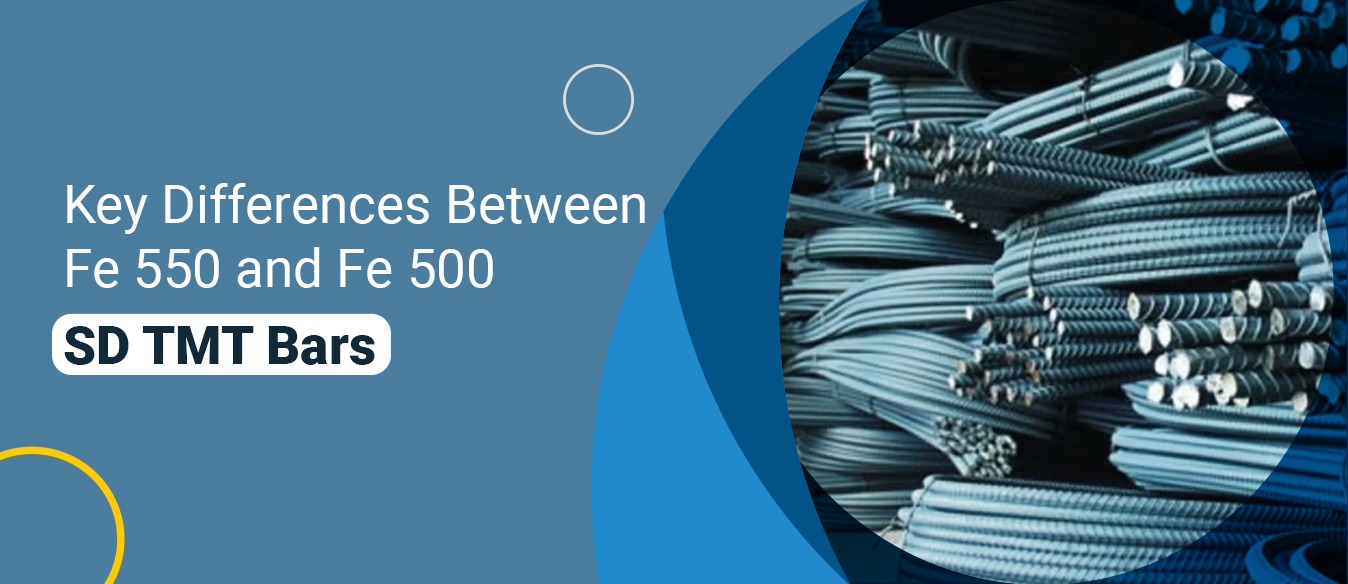
When you choose the right TMT bars for your construction project, understanding the differences between Fe 550 and Fe 500 SD TMT bars is crucial. Both grades offer specific advantages depending on the structural requirements but differ in strength, flexibility, and application.
As a premier manufacturer of Fe 550 SD TMT bars, Satya Steel, a subsidiary of the Shreesatya Group, is committed to providing the highest quality products for diverse construction needs. With advanced technology and stringent quality control, Satya Steel ensures that every Fe 550 SD bar is engineered for maximum strength, durability, and performance.
Whether you’re building bridges, dams, or high-rise buildings, Satya Steel’s Fe 550 SD TMT bars offer superior corrosion resistance, thermal stability, and crack resistance. Our dedication to innovation ensures that we deliver products that meet and exceed industry standards, making Satya Steel your trusted partner in building a strong, lasting future.
Here, we explore 15 key differences between Fe 550 and Fe 500 SD TMT bars to help you make an informed decision.
15 key differences between Fe 550 and Fe 500 SD TMT bars
1. Tensile Strength
- Fe 550 SD: Has a higher tensile strength, typically around 600 MPa, making it ideal for projects requiring superior load-bearing capacity.
- Fe 500 SD: Offers tensile strength of approximately 545 MPa, suitable for general construction purposes.
2. Yield Strength
- Fe 550 SD: With a yield strength of 550 MPa, these bars provide extra durability in structures facing heavy loads.
- Fe 500 SD: Has a yield strength of 500 MPa, suitable for standard residential and commercial constructions.
3. Ductility
- Fe 550 SD: Lower ductility compared to Fe 500 SD, meaning it’s less flexible but much stronger under stress.
- Fe 500 SD: Higher ductility, which makes it more flexible and easier to work with in various applications.
4. Application
- Fe 550 SD: Best suited for large-scale infrastructure like bridges, dams, and industrial projects that need to handle significant stress.
- Fe 500 SD: Commonly used in residential buildings, commercial complexes, and medium-sized structures.
5. Bending Ability
- Fe 550 SD: Due to its higher strength, Fe 550 SD bars are harder to bend, which requires more effort during construction.
- Fe 500 SD: Easier to bend and shape, making it more convenient for typical construction projects.
6. Corrosion Resistance
- Fe 550 SD: Offers enhanced corrosion resistance due to its superior chemical composition, making it ideal for coastal or humid environments.
- Fe 500 SD: Provides good corrosion resistance but may not be as robust in harsh environmental conditions as Fe 550 SD.
7. Cost
- Fe 550 SD: Generally more expensive due to its higher strength and performance capabilities.
- Fe 500 SD: More affordable and widely used in standard construction due to its cost-effectiveness.
8. Seismic Resistance
- Fe 550 SD: While strong, Fe 550 SD bars have lower ductility, which makes them less ideal for earthquake-prone regions.
- Fe 500 SD: Due to its higher ductility, Fe 500 SD is better suited for seismic zones, offering more flexibility and energy absorption during quakes.
9. Structural Load Capacity
- Fe 550 SD: Can handle heavier structural loads, making it a preferred choice for massive, load-bearing constructions.
- Fe 500 SD: Designed for moderate load capacities, suitable for standard buildings and constructions.
10. Fatigue Resistance
- Fe 550 SD: Has excellent fatigue resistance, ensuring long-lasting performance under repeated stress cycles.
- Fe 500 SD: Offers decent fatigue resistance but may not perform as well as Fe 550 SD in high-stress environments.
11. Crack Resistance
- Fe 550 SD: High resistance to cracking due to its superior strength, ensuring longevity in demanding construction conditions.
- Fe 500 SD: While resistant to cracking, it may not perform as well as Fe 550 SD in extreme conditions.
12. Thermal Stability
- Fe 550 SD: Better thermal stability under high temperatures, making it ideal for use in fire-prone areas.
- Fe 500 SD: Provides adequate thermal stability but may not perform as well as Fe 550 SD in extreme heat conditions.
13. Weight
- Fe 550 SD: Due to its higher strength-to-weight ratio, less quantity is required for the same construction, reducing overall material usage.
- Fe 500 SD: Heavier due to its lower strength-to-weight ratio, often requiring more material for similar structural strength.
14. IS Standards Compliance
- Fe 550 SD: Complies with IS:1786 standards for higher grade TMT bars, ensuring performance in critical applications.
- Fe 500 SD: Complies with IS:1786 standards but for lower grade applications, provide ng a balance between strength and flexibility.
15. Longevity
- Fe 550 SD: Offers extended durability due to its higher strength, making it a long-term investment for critical projects.
- Fe 500 SD: While durable, it may not last as long as Fe 550 SD in heavy-duty applications.
Conclusion
Both Fe 550 SD and Fe 500 SD TMT bars are excellent choices, but the right selection depends on your project’s requirements. If you need superior strength and durability for large-scale, high-stress constructions, Fe 550 SD is the ideal choice. However, if you’re looking for flexibility, cost-effectiveness, and reliability for standard constructions, Fe 500 SD offers a balanced solution. Satya Steel, a leading manufacturer, offers top-quality Fe 550 SD TMT bars, ensuring the best performance for your construction needs.